
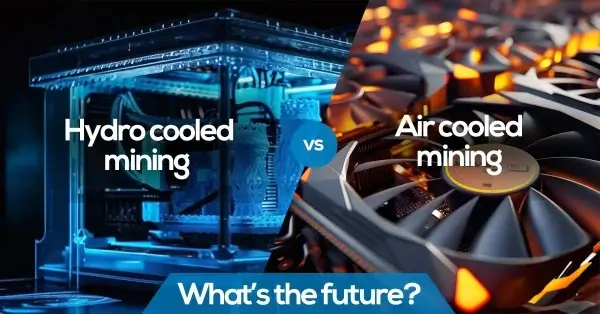
Hydro-cooled Bitcoin miners generally deliver higher efficiency, lower noise, and better heat control than air-cooled miners, making them ideal for large-scale operations. Air-cooled miners remain popular for their affordability, easier setup, and suitability for smaller mining farms.
Difference Between Hydro-Cooled and Air-Cooled Miners
Hydro-cooled miners use liquid-based cooling systems to remove heat from mining hardware, while air-cooled miners rely on high-speed fans and airflow to regulate temperature. Both designs power modern bitcoin mining, but they differ significantly in efficiency, noise levels, maintenance needs, and operational scale.
In air-cooled machines, multiple high-speed fans push hot air away from the ASIC chips to maintain safe operating temperatures. These miners are widely used in smaller mining setups because they are easier to install and require minimal infrastructure.
Hydro-cooled miners, on the other hand, circulate coolant through specialized heat exchangers. This system removes heat more efficiently, allowing the hardware to run at higher hash rates with improved thermal stability.
As mining hardware evolves, many large farms seeking the best bitcoin Miners for maximum performance are increasingly turning to hydro-cooling technology. It enables higher density deployments while reducing overheating risks in demanding environments like the Middle East.
How Air-Cooled Bitcoin Miners Work in Mining Operations
Air-cooled miners regulate temperature by using powerful fans that move large volumes of air through heat sinks attached to ASIC chips. The airflow dissipates heat generated during hashing operations.
This method has been the standard cooling approach since the early days of crypto miners. Many popular ASIC devices still rely on fan-based cooling because it is simple, cost-effective, and compatible with basic mining setups.
However, air-cooled systems can struggle in extremely hot climates. In regions such as the UAE, ambient temperatures can place additional strain on mining equipment, forcing operators to invest in extra ventilation or air conditioning.
Despite this limitation, air-cooled miners remain attractive to individual miners and small facilities due to their lower upfront cost and straightforward maintenance requirements.
How Hydro-Cooled Bitcoin Miners Improve Thermal Efficiency
A hydro cooled bitcoin miner uses liquid coolant to absorb and transfer heat away from ASIC chips more efficiently than air. The coolant circulates through pipes and heat exchangers, maintaining stable temperatures even under heavy workloads.
Because liquid conducts heat far better than air, hydro-cooling systems allow miners to run at higher performance levels without overheating. This technology significantly reduces thermal stress on the hardware components.
Mining farms using hydro-cooled infrastructure can operate equipment closer together while maintaining stable temperatures. This increases mining density and maximizes available facility space.
For large-scale operations targeting industrial-level hash power, hydro-cooling provides a powerful advantage in efficiency and operational reliability.
Which Mining System Delivers Better Performance
Hydro-cooled miners generally outperform air-cooled machines in sustained performance because they maintain lower operating temperatures during intensive hashing workloads.
Lower temperatures allow ASIC chips to operate closer to their optimal performance range. This leads to improved stability and reduced throttling during long mining sessions.
In contrast, an air cooled bitcoin miner may reduce performance automatically when temperatures rise too high. This protective mechanism prevents hardware damage but can temporarily reduce hash rates.
For professional mining farms aiming for consistent uptime and maximum output, hydro-cooling often provides the more reliable performance solution.
Energy Efficiency Comparison Between Hydro and Air Cooling Mining
Energy consumption plays a crucial role in mining profitability. Cooling technology directly impacts the total energy required to operate a mining facility.
Hydro-cooling systems typically deliver better energy efficiency because liquid cooling removes heat more effectively with less reliance on power-hungry fans. This can reduce the overall energy footprint of large mining farms.
Many modern hydro-cooled ASIC models are also designed as energy efficient ASIC miner solutions, delivering high hash rates with improved power-to-performance ratios.
Air-cooled miners, however, often consume additional electricity through high-speed fans and external cooling infrastructure, especially in warmer climates where airflow alone may not be sufficient.
Noise Levels: A Major Factor for Mining Environments
Noise is another important consideration when selecting mining equipment. Air-cooled miners are known for producing significant sound due to their high-RPM fans.
Many standard air-cooled ASIC miners operate between 70 and 90 decibels, which can be comparable to the noise level of heavy machinery. This makes them less suitable for residential or office environments.
Hydro-cooled miners, in contrast, produce far less noise because they rely on liquid circulation rather than multiple high-speed fans.
This quieter operation makes hydro-cooling particularly attractive for data-center-style mining facilities or indoor installations.
Maintenance and Operational Complexity of Air-cooled and Hydro-cooled miners
Air-cooled miners are generally easier to maintain because they rely on simpler mechanical systems. Regular cleaning of fans and dust filters is usually enough to keep them running efficiently.
Hydro-cooled miners involve additional components such as pumps, coolant circulation systems, and heat exchangers. These systems require proper installation and occasional monitoring to ensure optimal performance.
However, when managed correctly, hydro-cooling can actually extend hardware lifespan by maintaining more stable operating temperatures.
For experienced operators managing large mining farms, the added complexity is often worth the performance benefits.
Which Cooling System Works Best in the UAE Climate
The hot climate of the UAE makes cooling technology a critical factor for mining operations. High ambient temperatures can push air-cooled miners close to their thermal limits during peak summer months.
Hydro-cooling provides a strong advantage in such environments because liquid cooling removes heat more effectively regardless of external temperatures.
Many industrial mining facilities in hot regions are now adopting hydro-cooling to maintain consistent performance and reduce overheating risks.
As the industry evolves, understanding the future of Bitcoin mining technologies and cooling innovations becomes essential for miners planning long-term infrastructure investments.
Cost Considerations: Air-Cooled Miners vs Hydro-cooled Miners
Air-cooled miners typically have lower upfront costs because they require minimal additional infrastructure. This makes them accessible for beginners and smaller mining operations.
Hydro-cooled systems require specialized setups including liquid cooling loops, heat exchangers, and compatible ASIC hardware. This increases the initial investment cost.
However, hydro-cooling can provide better long-term returns through improved efficiency, reduced overheating risks, and longer hardware lifespan.
For large-scale mining farms focused on maximum profitability, hydro-cooling can become more cost-effective over time.
Final Thoughts: Hydro vs Air Cooling in Modern Bitcoin Mining
Both cooling systems play an important role in the evolving world of crypto miners. Air-cooled miners offer simplicity and affordability, while hydro-cooled miners deliver superior efficiency and performance.
For miners operating in high-temperature regions like the UAE, hydro-cooling can provide significant operational advantages, particularly for large-scale deployments.
As mining technology continues to advance, choosing the right cooling system will remain a key factor in achieving sustainable and profitable bitcoin mining operations.
FAQ
Are hydro-cooled Bitcoin miners more efficient than air-cooled miners?
Yes, hydro-cooled miners are generally more energy efficient. Liquid cooling transfers heat faster than air, allowing mining hardware to run at optimal temperatures. This helps improve performance stability and makes hydro-cooled systems attractive for large-scale bitcoin mining operations.
Are air-cooled Bitcoin miners still a good option for mining?
Yes, air cooled bitcoin miners remain popular because they are affordable, easy to set up, and widely available. They work well for small mining farms, individual miners, or facilities with proper ventilation and cooling infrastructure.
Do hydro-cooled miners produce less noise than air-cooled miners?
Yes, hydro-cooled miners are significantly quieter. Air-cooled crypto miners rely on high-speed fans that can generate 70–90 dB of noise, while hydro-cooled systems use liquid circulation, which greatly reduces operational noise levels.